How can beginners judge the quality of Diamond Painting? 3 steps to distinguish between good and bad products.

—theirWant to get into diamond painting but are deterred by poor-quality kits? Many beginners are initially drawn to this art form by its sparkling patterns, only to find the canvas wrinkled, the diamonds dull, and the glue not sticking – their high hopes turn into a disaster. Don’t worry, this diamond painting beginner’s guide will walk you through the simplest 3 steps, from canvas and diamonds to glue, teaching you how to judge the quality of diamond painting kits and helping you avoid the pitfalls of inferior products.
I. Canvas: The Key to Determining the Base for Diamond Painting
diamond butMany people don’t know that the “soul” of diamond painting isn’t actually the diamond, but the canvas. A good canvas ensures your entire work is flat, the colors are accurate, and the diamonds adhere smoothly.
How to judge canvas quality?
thick, resilient material,
often oilcloth or a blend of canvas and canvas. They are thick and resistant to deformation. They feel substantial in your hand, unlike flimsy plastic film.
The printing is clear and the colors are vibrant;
check for blurry symbols or color casts. If you need a magnifying glass to discern the symbols, the printing resolution is too low. High-quality diamond painting canvases exhibit distinct color gradations and clean, crisp edges for the symbols.
Good wrinkle and moisture resistance:
After receiving the canvas, gently lay it out. If it remains flat and bubble-free after several hours, it indicates that the base fabric and adhesive layer are well bonded. If obvious creases or wrinkles appear, it is likely made of low-end materials.
Common problems with inferior canvases
- It’s too thin; it wrinkles as soon as you stretch it.
- Blurry colors, misaligned printing;
- The adhesive layer is uneven, with lumpy protrusions.
Tip:
After receiving the diamond painting set, you can press it down with a heavy book overnight, then try attaching a few diamonds to see if the canvas is firm and not slippery. This step can directly determine the product quality.
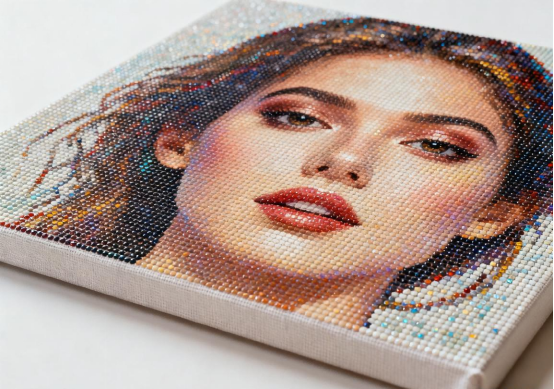
II. Diamond Painting: The consistency of luster and size determines the quality of the finished product.
Diamonds are the most attractive part of a diamond painting; their sparkling brilliance determines the “highlight” of the entire artwork. Unfortunately, many beginners buy diamonds that are either dull or of inconsistent size—resulting in a crooked and uneven image after they are laid out.
Three Standards of High-Quality Diamonds
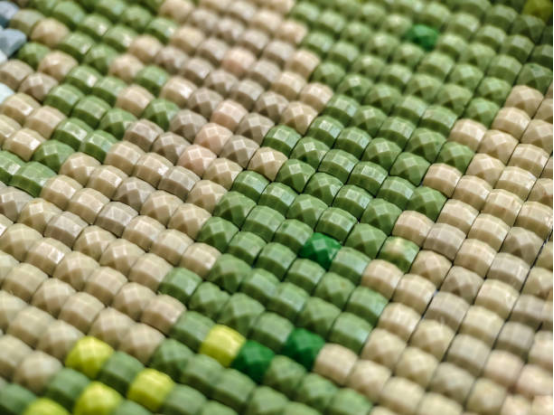
- A 5D faceted diamond will have a bright luster and distinct light refraction, displaying a three-dimensional, colorful light under light, while inferior diamonds often appear grayish-white and lack reflection. Hold a few diamonds up to a light source; if you can see clear, dancing points of light, then they are good diamonds.
- Consistent size and neat edges are
essential, especially for square diamonds, which must be perfectly aligned. Inconsistent sizes or asymmetrical angles will result in gaps or a wavy pattern after installation. High-end brand diamonds typically have an error margin of ±0.01mm. - Someoffer precise color matching and no color difference
. Some lower-priced sets have significant color variations, with diamonds of the same number exhibiting different shades. Laying them together not only disrupts the visual depth but also makes the overall effect appear “dirty.” High-quality diamonds, on the other hand, have a uniform, bright, and natural color.
Common problems with inferior diamonds
- It appears dull or grayish, and the refraction is not visible.
- The sizes are mismatched, and the sheets cannot be laid out neatly.
- Significant color deviation or color mixing.
Practical advice:
After opening the diamond packaging, select a few diamonds and try placing them in a corner of the canvas to observe whether they adhere firmly and neatly. If they reflect a clear luster under light and are arranged evenly, it indicates that the diamonds are of good quality.
III. Glue: The sticky soul of diamond painting
No matter how fine the diamonds or how perfect the canvas, if the glue is subpar, the whole thing is a failure. Adhesion is the core indicator of the quality of diamond painting glue. To judge its quality, the key is to see how firmly it adheres.
Three details to judge the quality of glue
- Whether or not a pourable adhesive is used:
High-end diamond painting brands all use pourable adhesive, which has a transparent, elastic, and highly durable surface. In contrast, double-sided tape canvases are more prone to losing their adhesiveness due to climate and humidity. - transparent andlayer should be uniform and free of bubbles.
Open the protective film and observe whether the adhesive layer is smooth and transparent, and whether there are bubbles or wrinkles. If the adhesive layer is whitish or of uneven thickness, it often indicates a low-quality production line. - -humidityHigh-quality glue is durable and prevents
diamonds from falling out. It remains stable even in high humidity environments, ensuring the diamonds stay firmly in place even after months of storage. Inferior glue, on the other hand, is prone to coming unglued, and the diamonds will slip off with the slightest touch.
The characteristics of inferior glue
- slip on.It has a pungent, glue-like smell and is easy to slip.
- The rhinestones came off a few hours after being applied.
- The edges of the canvas are oozing glue and feel greasy.
Beginner’s test:
Attach a few rhinestones and let it sit for 24 hours, then gently shake the cloth. If the rhinestones remain firmly in place, the adhesive is good; otherwise, it is recommended to seal it or return it as soon as possible.
IV. How to systematically judge the quality of a diamond painting?
To quickly assess the overall quality of a diamond painting, you can follow these steps:
- clear.First, look at the canvas: the material is thick and the printing is clear;
- Next, examine the diamonds: they have excellent luster and are of uniform size.
- Finally, consider the glue: cast-in type is best.
If all three of the above criteria are met, then this product set is likely worth buying.
Additionally, beginners are advised to choose a medium size (around 40×50cm), which allows for a quick experience of the complete assembly process and facilitates practice.
V. Common pitfalls to avoid when painting diamonds
Many beginners are easily attracted by price when choosing diamond painting. However, a low price doesn’t necessarily mean high quality; it might even indicate shoddy workmanship. For example:
- The low-priced sets have insufficient diamond quantity: color defects are severe.
- The canvas has many creases and is difficult to flatten; it cannot be framed and displayed after completion.
- Inferior glue: The diamonds fell off a few days after being applied.
VI. Conclusion: Careful selection is key to enjoying the pleasure of diamond painting.
Diamond painting is not just a craft but also a form of therapy. Watching diamonds sparkle on the canvas brings a sense of accomplishment and relaxation.
And the key to this enjoyment is choosing the right product.
Please remember the three golden rules:
Examine the canvas thickness and printing; assess the
diamond’s luster and size;
and measure the glue’s stickiness and durability.
By mastering this method, even complete beginners can easily identify the quality of diamond painting kits, avoid pitfalls, and turn every creative experience into a pleasant one.