Diamond painting glue review: Applicable scenarios and durability of different glue materials

If you’ve ever done diamond painting, you’ve definitely experienced that feeling of “the whole world lights up the moment the diamonds are applied.” But a few days later, if a few diamonds fall off, your mood instantly plummets. In fact, most people, when faced with this problem for the first time, doubt their own skills. But the truth is—the glue is the real culprit.
Many beginners don’t realize that the type and quality of diamond painting glue directly determine the user experience and lifespan of your diamond painting. This review will take you through a comprehensive understanding of various diamond painting glues from three dimensions: “adhesion, durability, and applicable scenarios.”
Table of Contents
1. Why does the quality of the glue determine the quality of the diamond painting?
To put it bluntly: whether a diamond can be firmly attached depends entirely on the glue. The canvas of the diamond painting is just a medium; what truly makes the diamond “fit” is that layer of transparent glue. How firmly it adheres, whether it bubbles, and whether it resists moisture all affect the final product.
For example, have you ever encountered this situation?
- The canvas was just unpacked, and the edges are no longer very sticky;
- Halfway through, they discovered the diamonds wouldn’t stick.
- A few months after the artwork was hung up, the diamonds started to fall off.
This all indicates poor adhesive quality. Canvases using high-quality castable adhesive can last 3-5 years, while works pasted with ordinary double-sided tape often begin to age after only six months.
In short: glue is the soul of diamond art. If you choose the wrong glue, even the best design and diamonds will be wasted.
II. Two common types of glue for diamond painting
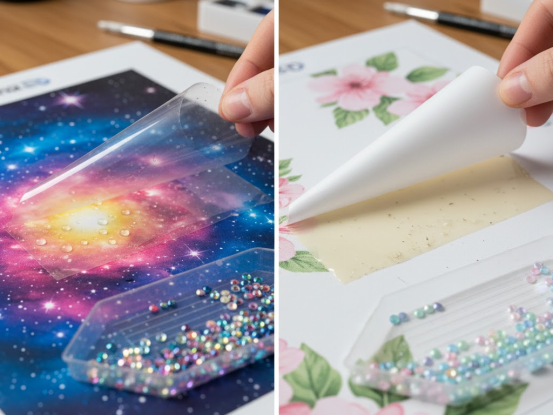
In mainstream diamond painting sets on the market, there are two main types of glue: castable glue and double-sided adhesive. They sound similar, but the experience is worlds apart.
2.1 Poured Glue – The Preferred Choice for Advanced Players
This adhesive is produced in liquid form and is evenly “poured” onto the canvas pattern area. Once dry, it forms a thin, soft adhesive layer. It is not prone to bubbling and is moisture-resistant.
advantage:
- It has strong adhesion, and the diamonds will hardly fall off once applied;
- Not easily affected by humidity;
- The production process is smoother, and the protective film is a transparent plastic film, making it easy to work in sections.
- The finished product has a longer lifespan and is very suitable for long-term preservation or framed display.
Minor drawbacks:
- High cost, typically found in mid-to-high-end diamond painting brands;
- The drying time is a bit long, so be patient during the initial stages of production.
In short: If you want your artwork to last for many years, prioritize a diamond painting kit with pourable glue.
Common 2.2Common2.2 Double-Sided Adhesive – Common in Entry-Level Models
The canvas surface of this adhesive is a single sheet of double-sided tape. It’s inexpensive, quick to mass-produce, and a standard component of many starter kits.
advantage:
- It’s low-cost, so beginners can give it a try;
- No drying period is required; it’s ready to use right out of the box.
shortcoming:
- moisture. It is prone to bubbling and losing its stickiness when exposed to moisture.
- The edges easily attract dust, affecting the rhinestone application experience;
- It has a short shelf life and is not suitable for long-term display.
Simply put: it’s suitable for practice, not for collecting. If you just want to experience the fun of diamond painting, it can do that; but if you want to make a “family heirloom” finished product, you’ll have to switch to a casting method.
III. Comparison of Applicable Scenarios for Different Types of Diamond Painting Glue
| Use cases | Recommended glue type | Reasons for recommendation |
| First attempt/practice | Double-sided adhesive tape | Inexpensive and easy to use |
| For long-term preservation/framing display | Casting adhesive | Strong adhesion and long lifespan |
| Humid climate (such as in the south or tropics) | Casting adhesive | Excellent moisture resistance |
| Production in stages (requiring repeated film covering) | Casting adhesive | The adhesive layer is stable and not prone to aging. |
humidity, According to actual measurements, the adhesive properties of castable adhesives are stable at 40–80% humidity, while the adhesive properties of double-sided adhesives decrease by nearly 30% when the humidity exceeds 60%.
; otherwise, Tip: If you live in a humid area, such as a coastal city, do not choose double-sided tape; otherwise, the finished product may start to “fall off the rhinestones” after a few months.
IV. How do you determine which type of glue you used in your diamond painting?
Those new to diamond painting often find it difficult to distinguish the real from the fake. Actually, it’s quite simple; the following steps will allow you to tell the difference at a glance:
Check the color of the protective film: transparent films are usually made with cast adhesive, while white and opaque films are mostly double-sided adhesive.
Observe the canvas surface: if the edges are exposed and easily attract dust, it is most likely double-sided tape.
Touch test: Gently peel off the protective film. The cast adhesive is smooth and slightly elastic; the double-sided tape is drier.
Try applying a few diamonds: After applying them, leave them for 24 hours to see if they slip off or if the adhesion changes.
imitations.” By keeping these points in mind, you’ll be more confident when buying diamond paintings next time and less likely to be fooled by “low-priced, high-quality imitations.”
V. Tips for extending the lifespan of a finished diamond painting
After completing your diamond painting, to make it last longer and stay sparkly, keep the following points in mind:
- Sealing treatment: Apply a thin layer of special sealant for diamond painting to enhance dust and moisture resistance.
- Avoid direct sunlight: Ultraviolet rays will cause the adhesive layer to age and yellow.
- Framing and display: Framing is not only aesthetically pleasing but also effectively prevents diamonds from falling out.
- Storage environment: Keep dry and at room temperature; avoid high-humidity environments.
These steps may seem like minor details, but they can help preserve a diamond painting for 2–3 years longer.
VI. Conclusion: Choosing the right glue is key to victory.
If you’re a beginner, a double-sided tape kit is enough for you to practice; but if you’ve already fallen in love with diamond painting and want to hang your work on the wall, give it to a friend, or even collect it, then pourable adhesive is definitely the best choice.
in short:
- Want to save money and play around with it for a short time? Choose double-sided tape.
- For preservation, display, and collection, choose castable adhesive.
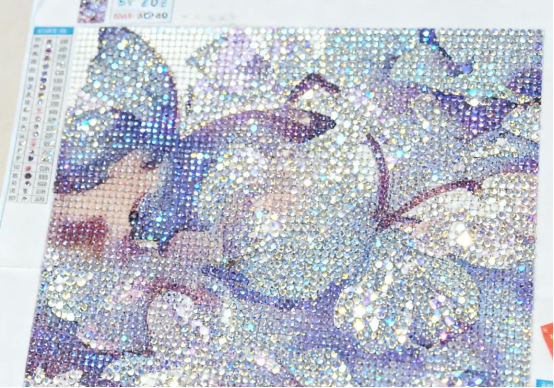
Don’t let a seemingly insignificant layer of glue ruin hours of your work. Truly high-quality diamond painting is not just about the sparkle of the diamonds but also about each diamond being securely placed in its proper position.