How to help children with autism develop skills through crafts

Arts and crafts are valuable opportunities for all children, especially those with autism spectrum disorder (ASD), to develop a variety of life skills. Many therapists working with children with autism use creative activities to increase engagement, as these projects not only enhance manual skills but also cultivate a variety of other skills. Especially in the home setting, arts and crafts can foster parent-child bonding and provide enjoyable experiences for children.
As a parent, you can help your child develop confidence and fine motor skills by participating in these activities together. They can also stimulate creativity and foster problem-solving skills. Even if you’re not an art enthusiast yourself, these activities offer a simple and engaging way to share quality time with your child and enhance understanding and interaction.
Choosing the right art project
Autism is a spectrum disorder, and each child’s presentation and needs are unique. Some children may excel with language and social interaction, while others face greater challenges in these areas. The key is to choose the right program based on your child’s personality and interests to ensure they feel happy and accomplished while participating.
For example, for children with sensory sensitivities, brightly colored or textured craft materials may attract their attention more, while for other children, simple patterns and clear steps may make it easier to get started. Parents can try to gradually adjust the content of the activities according to their children’s reactions and find their favorite form of craft art.
Provide appropriate guidance and support
Parental guidance is crucial to helping children complete these projects. Many therapists use a “scaffolding” strategy, gradually letting go as children progress from simple tasks to more complex skills. This means you can give your child more support at the beginning of the project, gradually guiding them through the challenges they encounter, and then reduce intervention as they become more confident.
You can support your child by:
Provide demonstrations: Help your child understand how to complete a task by showing them how to do it. For example, when doing diamond painting , you could first show your child how to properly place the rhinestones.
Break down the task: Break down complex steps into smaller parts and let the child complete them step by step. For example, divide the painting into several sessions and focus on completing a small part each time.
Positive feedback: Give your child positive feedback when he or she completes each small step, even if it is just a simple “well done”. This positive encouragement can make the child feel a sense of accomplishment.
Provide choices when appropriate: Let children participate in deciding the materials or design of the activity to enhance their sense of involvement. For example, let them choose the pattern for diamond painting or design the color combination for their sensory bottle.
Craft projects especially for children with autism
diamond painting
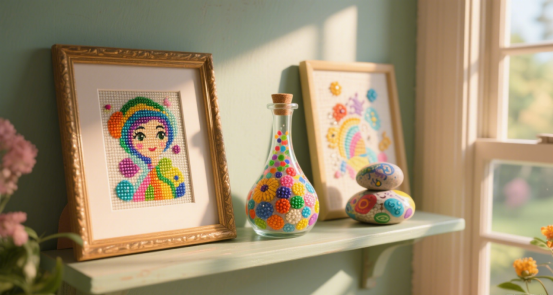
Diamond painting is an art form that combines paint by numbers and cross-stitch, using resin rhinestones to create shimmering mosaic patterns. This activity is not only creative but also helps children with autism develop concentration, patience, and fine motor skills while enjoying the process.
diamond painting is its ease of use: the canvas clearly indicates the color and number of each area, and children can follow these instructions to stick the diamonds one by one. This process helps children improve their color recognition and shape matching skills, while also improving their hand coordination and detailed observation.
Furthermore, the tactile and visual appeal of diamond painting is particularly appealing to children with autism. By touching and feeling the shape and luster of diamonds, children enjoy a unique sensory experience. Once completed, you can frame your work and hang it in your home, enhancing your home decor while allowing your child to feel proud of their creation.
DIY Sensory Bottles
Sensory bottles are a low-cost and fun craft project that not only helps children develop fine motor skills through hands-on activities but also provides sensory stimulation. Parents and children can choose a bottle and add glitter, beads, colored sand, paint, or other small items. Children can shake and spin the bottle to observe how the different substances react.
This activity can help children with autism improve their tactile and visual perception, while also relieving anxiety and stress and providing a way to relax. Sensory bottles are great for children when they are experiencing emotional ups and downs, and can be a soothing tool to help them calm down.
Painted Stone
Painting rocks is a simple and fun activity for children of all ages. By painting rocks with various colors, patterns, or images, children develop hand-eye coordination and spark creativity. Together, you can collect rocks, choose colors, design patterns, and paint. As they do this, they’ll learn how to control the brush and master detailed techniques.
At the same time, stone painting is also a social activity. Children can share their works with friends and family, and even participate in community activities to display their works and gain recognition and praise from others.

Make every craft activity fun
Handicraft activities can not only help children with autism develop practical skills, but also bring them sensory enjoyment and emotional satisfaction. When choosing a project, it is important to adjust it according to the child’s interests. There is no need to pursue perfection too much, but to make the process itself full of fun and learning.
These activities also foster parent-child interaction and enhance understanding and communication between parents and children. Whether it’s diamond painting , sensory bottles, or painted rocks, each project has its own unique value, helping children gain confidence, develop social skills, and improve fine motor skills while enjoying creation, ultimately learning to apply these skills in life.
Most importantly, the process of crafting is an enjoyable learning process in itself, without the need for deliberate pursuit of perfection. Let children have fun and accumulate experience through continuous experimentation and exploration, which is the most valuable achievement.