Diamond Painting Enthusiasts’ Guide: Rational Consumption and Budget Management, So That Your Love Is Not Hijacked by “Stockpiling”

For diamond painting enthusiasts, the small moments of opening a shopping website, seeing the “Add to Cart” button for a favorite piece, the anticipation of waiting for the package to arrive, and the excitement of unwrapping the diamond package—these moments have long become life’s little joys. But as the hoarding piles up—unopened canvases piled in corners, half-finished works gathering dust, and diamond paintings purchased at a low price but of poor quality sitting unused—the initial passion can quietly turn into a “sweet burden.” In reality, the key to diamond painting consumption isn’t “buying more” but “getting the best value.” This budget management guide will help you avoid the trap of impulsive spending and transform every investment into lasting creative joy.
1. Beware of the “low price trap”: Don’t let cheapness turn into waste
Many enthusiasts are easily attracted by diamond paintings advertised on shopping platforms as “$2 a piece” with “9.9 yuan free shipping,” thinking it’s a good deal and can’t help but place bulk orders. However, after calculating the costs, you’ll find that these low-priced products often have hidden costs that make the money spent less than ideal.
1. The hidden losses of low-priced diamond painting: loss of time and experience
- A quick finish doesn’t necessarily mean a worthwhile investment
. Diamond paintings are often small-scale, partially diamond-applied works (for example, just a face or a small scene, with the rest of the work printed) and can be completed in 10-20 minutes. While seemingly effortless, they lack the immersive creative joy of diamond painting. In contrast, a large, fully diamond-applied canvas, costing $40 and requiring 30-40 hours to complete, costs only $1 per hour, yet offers a long period of creative solace and a strong sense of accomplishment upon completion, making it a far more cost-effective alternative. - Quality issues slow down your work and saps your enthusiasm
. Common issues with low-priced canvases include wrinkles that are difficult to smooth out, poor glue adhesion, and rough or easily detached diamonds. Some people spend more time ironing the canvas than applying the diamonds, repeatedly ironing the canvas to smooth it out. They also experience uneven coloring mid-application, requiring the purchase of refill packs. And impurities in the glue require cleaning after application. These issues not only add to the frustration of the creative process but can also slowly diminish your love for diamond painting.
2. The “forgotten cost” of shipping time
Low-priced diamond paintings often come from overseas platforms. While you might be excited when placing an order, by the time the package arrives, your interest may have already faded, leaving them tucked away in storage, forever unused. If you stockpile multiple canvases at once, they risk being completely damaged by improper storage (moisture, pressure), wasting your money.
2. Avoid the “stockpiling addiction”: Understanding “why you buy” is more important than “how much you buy.”
?””My collection is piled high, but I have no time to paint,” “I want to buy new pieces as soon as I see them, even if I still have a dozen unopened at home”—this is a common problem for many diamond painting enthusiasts. Stockpiling is essentially impulse buying, and the key to solving this problem is to first clearly understand: “Why are you buying diamond paintings ?”
1. Ask yourself three questions to avoid impulsive orders
Before you click “Add to Cart” every time, take 30 seconds to ask yourself:
- Do I really like this design? Or is it just cheap?
Many people buy designs they don’t like because of a big discount. For example, they might prefer a landscape design, but they’re tempted to order one because of a “buy one get one free cartoon design” offer. This leads to a lack of motivation to complete the design. It’s recommended to add a design you like to your favorites, observe it for three days, and then decide to purchase it if you still want to draw it. - “Do I have time to finish it?”
Estimate the time required based on the size of the canvas: a small size (20×30cm) takes about 5-8 hours, a medium size (40×50cm) takes about 20-30 hours, and a large size (over 60×80cm) may take 1-2 months. If you’re busy with work or have unfinished works, it’s recommended to hold off on buying new ones to avoid the added pressure of stockpiling. - “Do I have room to store them at home?”
Diamond paintings need to be stored flat, avoiding folding or squeezing. When storage space is limited, stocking too many canvases not only takes up space but can also damage them. It’s better to follow the principle of “finish one, buy another” and treat each painting with care.
2. Clearing out idle inventory: giving old canvases a new lease of life
- like,”canvases and
Sort them by “Super Like (Must Paint),” “Moderate Like (Can Paint),” or “Dislike (Unused).” For those you “don’t like”, you can sell them on a second-hand platform or give them to friends, freeing up space and allowing your canvases to be used to their full potential. - 5×5 cmSmall canvases (such as 5x5cm cartoon portraits or small landscapes) can be broken down and assembled into a “collage.” Framed and fixed to a common base, they can be hung in the entryway or study. This not only makes up for unused space but also creates a unique home decor, making it more meaningful than simply storing them separately.
3. Rational Budget: Spend Money on “Improving Experience”
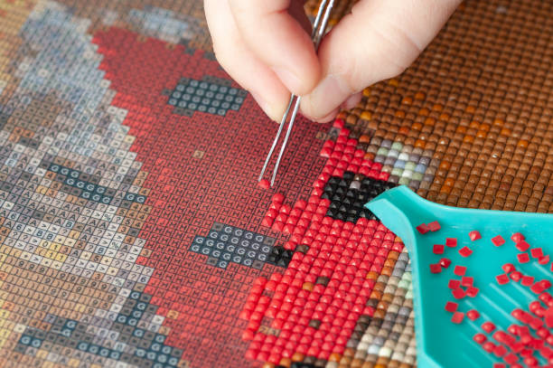
.The joy of diamond painting comes not only from the sense of accomplishment after completion but also from the healing feeling of the creative process . Rather than pursuing quantity, it is better to invest in quality and make every creation a pleasure.
1. Give priority to high-quality canvas with high cost performance
Although the unit price is slightly higher ($40-100), the experience is better:
- Canvas: 100% polyester fiber, smooth and wrinkle-free; the glue is evenly applied and has strong viscosity, so the diamonds are not easy to fall off after being attached.
- Diamond: The resin diamond has more than 16 facets and good luster. The picture is shiny after pasting, as if it is inlaid with real diamonds.
- Details: Although the full diamond style is time-consuming, the complete creative process is more enjoyable. The finished work has a strong sense of home decoration, and guests can also feel the exquisiteness when visiting.
2. Create a monthly diamond painting budget
Based on your income and living expenses, set a monthly shopping budget (e.g., $50-100) and stick to it:
- Special account management: Deposit a separate budget amount and use it only for purchasing diamond painting products to avoid misappropriation.
- Comparison shopping: Don’t blindly pursue brands or low prices. Compare the quality of the canvas, the luster of the diamonds, and the shipping time. Choose products that meet your quality standards, have designs you like, and are reasonably priced, rather than simply pursuing the “most expensive” or “cheapest.”
For diamond painting enthusiasts, true happiness isn’t about how many canvases they own but rather about meticulously completing each one and feeling a sense of healing with each creation. Rational consumption isn’t about suppressing passion but about fostering it. Freed from the pressure of stockpiling and the annoyance of quality issues, you can truly immerse yourself in the joy of plastering canvases with diamonds, allowing this passion to become a small joy in life, not a burden. Ultimately, the allure of diamond painting lies in the creative process, not the sheer number of pieces.