
If you’re new to diamond painting, you might be a bit confused by some of the jargon. However, these jargons aren’t intentional barriers; they’re the common language used by enthusiasts and the community. Understanding them will not only help you get started faster, but also allow you to be more professional in selecting materials, communicating, and creating.
Here, I’ve compiled a “Diamond Art Dictionary” covering over 60 terms that will be useful to everyone from beginners to experienced diamond experts. I recommend saving this for future reference when reading manuals, choosing accessories, or interacting with friends in your circle.
1. Basic terminology (tools and materials)
Canvas
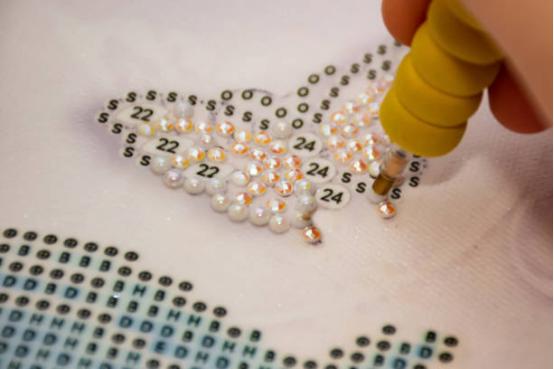
painting is a base material printed with patterns and symbols and coated with a sticky primer. It is the foundation of diamond painting and is typically made of fabric, canvas, or a blend. The thickness and glossiness of the primer on different canvases will affect the final result.
Drills are the core elements of
diamond painting : tiny, sparkling particles. They are sometimes called “diamonds” or “diamond beads.” The texture and facets of different diamonds affect the visual effect of the work.
Round Drill / Square Drill
- Round drill: The top is rounded, making it easier for novices to operate the drill.
- Square diamonds: highly fitted, with almost no gaps, are often preferred by experienced players because of their more refined visual effects.
Poured Glue:
Pour transparent glue onto the canvas, allowing the entire area to be directly attached with diamonds. The advantages are smoothness and strong adhesion, but care must be taken to prevent drying out.
Double-Sided Adhesive:
Some canvases come with double-sided tape directly attached, with a protective film on the back. You can peel it off and then apply diamonds. While this is convenient, the adhesive may not be as durable as reverse adhesive.
Tray / Diamond Tray
is a small tool for holding diamonds. It has a groove design to facilitate the arrangement of diamonds. When using, you can shake the tray slightly to make the diamonds face up.
An applicator/drill pen
is a tool used to remove and apply diamonds. Dipping the tip of the pen in wax helps it better grip the diamond. There are many interchangeable-tip pens available to suit different creative styles.
Wax / DP Wax
Small pieces of wax are used in diamond pens to help pick up diamonds. Without it, the pen tip will not be able to hold the diamond.
the Legend / Color Key / Color Chart
canvas lists the symbols and corresponding diamond colors, and is the “instructions” for attaching diamonds.
Inventory
When you receive the kit, check that the diamonds, tools, canvas, etc. are complete. Checking the materials is the first step to ensure a smooth creation.
The Light Pad/Light Board
is placed under the canvas to provide backlighting, making it easier to see the symbols and reducing the time you spend looking down. For long-term diamond enthusiasts, this is almost a must-have tool.
The Straightening Tool / Ruler Edge
helps align diamonds and ensures a neat finish. It is particularly suitable for square diamonds.
the
canvas after sticking the diamonds will help the diamonds stick more firmly and reduce the risk of falling off later.
Cover / Protective Film:
A transparent film covering the canvas surface to prevent dust and dirt. It is gradually removed when applying diamonds.
Sectioning
divides the canvas into sections for diamond application, making it easier to manage and reducing errors. Many experienced players recommend this method, especially for large-scale works.
The Multi-Placer
can take multiple diamonds at a time, which is suitable for large areas of the same color and improves efficiency.
The Single Placer
selects one diamond at a time and is ideal for details or irregular areas.
Spare / Extras
Most kits will provide extra diamonds to prevent loss.
Stash
Refers to the inventory of unstarted kits or diamonds. Hobbyists often say “my stash is getting bigger and bigger.”
WIP
stands for Work in Progress but Not Completed. A commonly used abbreviation in the industry.
PR/Unboxing
: Display and share new brand products. Many diamond painting bloggers will make unboxing videos.
Checkerboard
Tips for applying diamonds: apply them at the intervals first and then backfill to help achieve uniformity.
Color Blocking
allows you to paste diamonds of the same color in a large area at one time, saving time on changing diamonds.
Confetti
has areas with complex and intertwined colors, so it takes more time to apply.
AB Diamonds
‘ rainbow-reflective coating offers a rich brilliance.
3D / 5D
diamond facets. 5D diamonds are more sparkling and have a more three-dimensional feel.
The gap caused by the bending of the canvas after Rivers diamond application needs to be avoided.
Diamonds of different colors occasionally appear in Hitchhiker / Stowaway diamond bags, acting like “hitchhiker” diamonds.
Washi Tape
is a soft adhesive tape used for marking, fixing canvas, etc.
Kitting Up / Kitting Down
preparation / finishing kits and tools.
Release Paper
is the protective paper covering the adhesive on the canvas, which is torn off and then the diamonds are attached.
Legend Area
: The area on the canvas where symbols are printed, corresponding to the color of the diamond.
Drill Field
is the adhesive part of the canvas where the drills are to be attached.
Full Drill / Partial Drill
- Full diamond: diamonds are applied on the whole cloth;
- Partial drilling: only part of the area is taped.
Cover Minder
clamps the protective film to avoid blocking the canvas area.
Drill Vacuum
is a small tool used to clean up fallen diamonds or dust.
Sealer
sprays after diamond attachment to prevent diamonds from falling off.
Symbol / Color Code / DMC Codes
symbols and color codes to help compare diamond colors.
Training Wheels
are auxiliary markings to help novices accurately place the drill.
2. Advanced Terminology
Including Holographic Drill, Gradient Effect, Foil Diamonds, Custom Canvas, Micro Drill, etc., representing different processes, materials and effects.
Understanding these terms, you will find that diamond painting is not just a handicraft, but also a combination of visual art and creative language.
How to Use These Terms
- Read the instructions and identify quality and fit when purchasing kits
- Accurately express needs during community communication
- Place orders accurately when purchasing tools and accessories
- Improve the quality of your work and master technical terminology
IV. Conclusion
The terminology of diamond art painting is essentially a “creative language.” Mastering it will streamline your creative process, allowing you to better communicate, share, and improve your work. We hope this dictionary will be a valuable aid in your diamond painting endeavors, making each creation a joyful and fulfilling one.